Why Losing the Beat in Dance Class Isn't Actually About Rhythm at All
Quick Answer: Losing the beat in a group dance class is more often a working-memory bottleneck — trying to recall a new step sequence while simultaneously listening for the count — than an actual lack of rhythm; once the steps become familiar enough to stop consciously thinking about them, most people find the beat was never really the problem.
You can tap your foot perfectly to a song in the car, then completely lose the count the moment a new combination gets added in class — that gap is the real clue here.
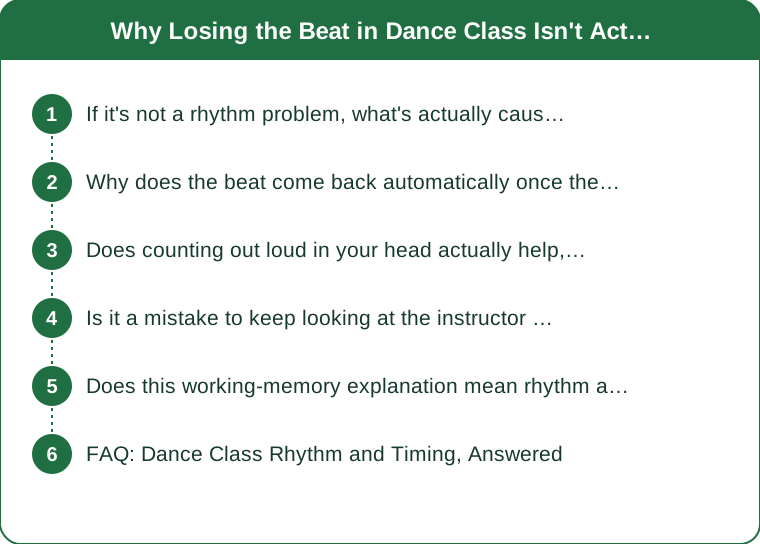
If it’s not a rhythm problem, what’s actually causing the beat to get lost?
Learning a new movement sequence occupies working memory heavily, and that same mental bandwidth is needed to track the musical count — when a step is unfamiliar, most of the brain’s attention goes toward simply remembering what comes next, leaving little left over for staying precisely on beat, even in someone with generally solid rhythm.
Why does the beat come back automatically once the steps feel familiar?
As a movement sequence becomes more automatic through repetition, it requires progressively less conscious working memory to execute, which frees up attention to reconnect with the music’s timing — this is why the same person who fumbled a brand-new combination in week one often nails the timing on that same combination by week three, without deliberately practicing rhythm at all.
Does counting out loud in your head actually help, or does it add to the mental load?
It can go either way — counting helps when the numbers themselves are more familiar than the step names, but it can add load when both the count and the steps are simultaneously new, which is why some instructors recommend focusing on just the steps first and layering the counting back in once the sequence feels more automatic.
Is it a mistake to keep looking at the instructor instead of trying independently?
Not necessarily a mistake early on — visually following an instructor’s movement is a legitimate way to offload some of the working-memory burden while a sequence is still new, though gradually weaning off constant visual reliance as steps become familiar helps build the independent recall that’s needed for faster future combinations.
Does this working-memory explanation mean rhythm ability doesn’t matter at all?
Not entirely — baseline rhythm perception still matters for the polish and precision of movement once steps are known, but it’s rarely the reason a beginner falls noticeably behind during a brand-new combination — that specific struggle is overwhelmingly a memory-load issue, not a rhythm deficiency.
FAQ: Dance Class Rhythm and Timing, Answered
Is it worth practicing choreography at home before the next class?
Yes — repetition outside class reduces the working-memory load during the actual class session, which frees up more attention for staying on beat during real-time instruction.
Should beginners stand in the front or back of a dance class?
Many instructors suggest a middle position — close enough to see clearly, but with peers nearby whose movement can also be referenced, which reduces the pressure of being highly visible while still learning.
Does slower music make it meaningfully easier to stay on beat while learning?
Generally yes — slower tempo gives more processing time per beat, which is why many classes intentionally slow music down when first teaching a new combination.
TL;DR:
- Falling behind the beat in a new combination is usually a working-memory issue, not a rhythm deficiency
- New steps eat up mental bandwidth that would otherwise track the music’s timing
- As steps become automatic through repetition, the beat tends to reconnect on its own
- Practicing at home and following an instructor visually both reduce the memory load in real time
You probably have better rhythm than that class made it feel like — the steps just hadn’t moved into muscle memory yet, and that part comes with reps, not talent.
Keep Reading
This article is for general informational and styling purposes only. Fit, sizing, and product availability may vary.
