Why Choreography Gets Easier When You Stop Watching the Feet
Quick Answer: Watching the feet is a detail-first strategy, and movement is not learned detail-first. Skilled learners watch the whole body and the shape it makes, listen for the rhythm structure, and let the feet follow. This works because motor learning is organised around chunks and patterns, not individual joint positions — and because the visual system tracks a whole moving form far more efficiently than it tracks one part. It is a change in where you look, and it usually produces a noticeable difference within one class.
It feels like the careful approach. It is actually the slow one.
Here is what to do instead.
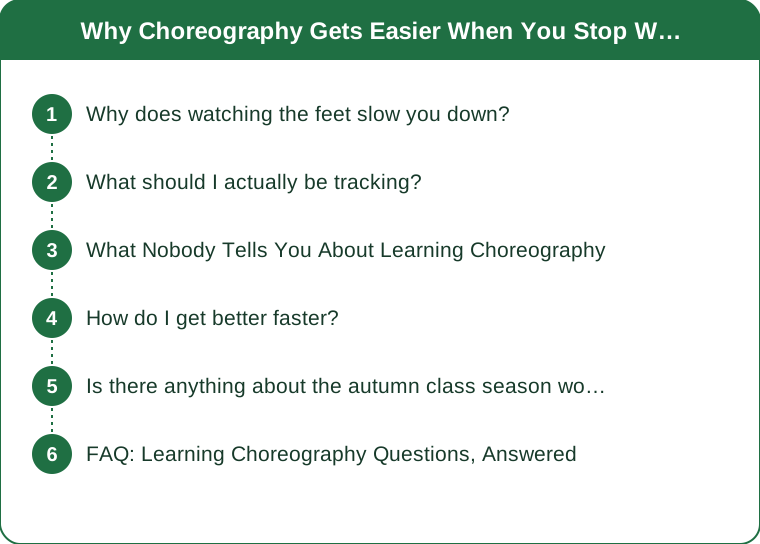
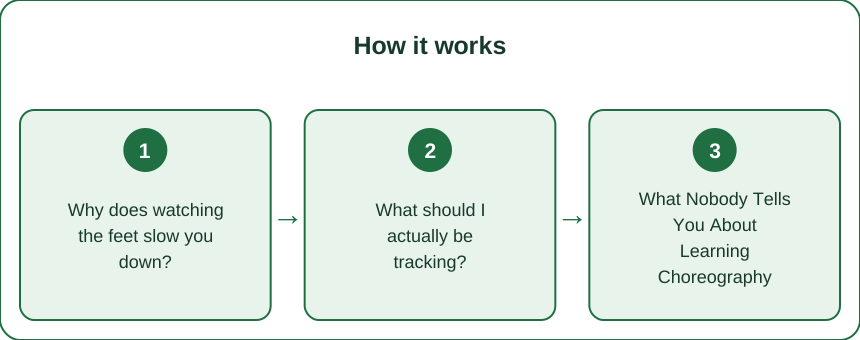
Why does watching the feet slow you down?
Three separate reasons, and they compound.
You are processing one part at a time. Watching the feet means building the movement from the ground up — left foot here, right foot there, then what are the arms doing. Sequential processing is much slower than pattern recognition, and choreography moves at the speed of the music, not the speed of your analysis.
You are looking down. Which changes your posture, shifts your balance backward, and removes your peripheral view of the room and of other dancers. Peripheral vision is how most people actually stay in time with a class, and looking down switches it off.
Feet are the least informative part. The overall shape of a movement, its direction, and its timing are all visible in the torso and the whole body outline. The feet are the consequence of the movement, not its cause — they go where the body sends them. Watching the outcome and trying to reverse-engineer the cause is genuinely harder.
What skilled learners do instead:
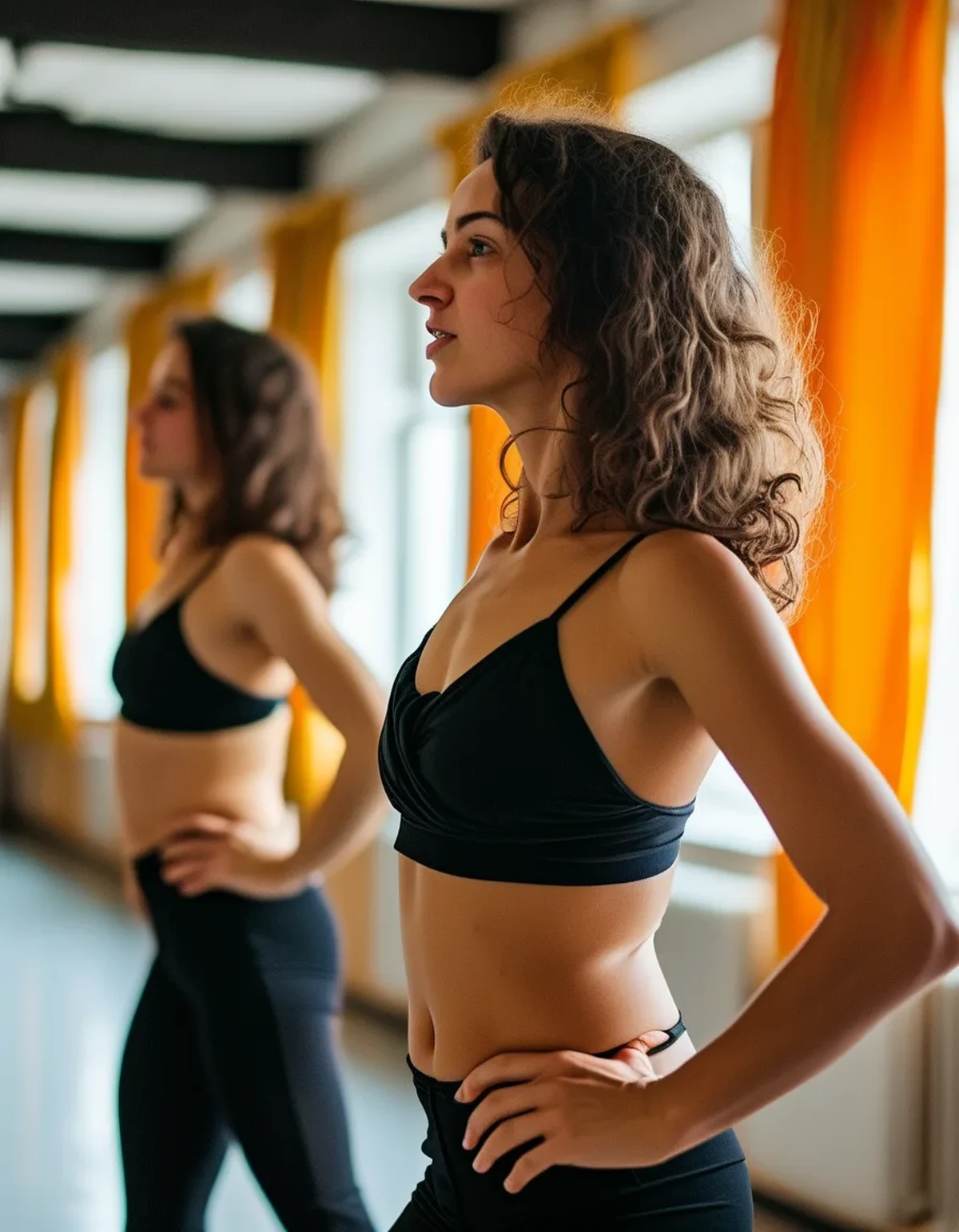
Watch the whole body, softly focused. Take in the shape rather than any part. This is the same visual strategy used in most sports for tracking an opponent.
Listen to the count structure. Most choreography is built in phrases of 8 counts. Knowing where you are in the phrase does more for keeping up than knowing what the feet do, because it tells you when the next change is coming.
Feel the weight shift. Almost all dance is about where your weight is. If you know which foot your weight is on, the step usually follows automatically.
Is this true for total beginners too?
More so. Beginners default to detail-watching because it feels safer, and it is the habit that keeps people a beat behind for months.
What should I actually be tracking?
In order of usefulness.
One: the weight shift. Which foot is carrying you. Most sequences become far simpler when described as weight left, weight right, weight left, hold rather than as a list of steps. If you only track one thing, track this.
Two: the direction of travel. Forward, back, side, turning. This is visible from across a room and it organises everything else.
Three: the count. Where you are within the 8. Instructors count for exactly this reason, and beginners often tune it out while concentrating on the visual, which is precisely backwards.
Four: the shape of the torso. Leaning, twisting, upright, low. The upper body communicates the character of a movement and it is much easier to copy than footwork.
Five: the arms, last. Arms are usually the easiest part to add once the legs and the timing are established, and trying to get them at the same time is what overloads people.
And a genuinely useful reframe: most choreography is a small number of movements repeated with variation. Learning the four building blocks is faster than learning the 32-count sequence, and instructors almost always teach it this way if you listen to how they break it down rather than watching the demonstration on repeat.
What if the instructor faces away and I still cannot see?
Then use the person in front of you, and use the count. In a mirrored studio, watching the instructor’s reflection removes the mirroring problem entirely — which is worth knowing, because reversing left and right in real time is a genuine cognitive load that has nothing to do with dance ability.
What Nobody Tells You About Learning Choreography
Everyone is a beat behind at first, including people who look fluent. Fluent-looking dancers are frequently half-improvising, covering the bits they do not know with confident movement. Committing to a wrong move looks better and teaches you more than hesitating on a right one.
Marking the movement is a real technique. Doing a small, low-energy version while you learn — walking the steps rather than jumping them — is what professional dancers do in rehearsal. It lets you learn the pattern without spending the energy, and it is completely acceptable in any class.
Your body learns it after class. Motor consolidation happens during rest and particularly during sleep. A sequence that felt impossible on Tuesday is frequently much easier the following week with no practice in between. This is well established and it means the second class always feels better than the first.
Repetition of the same class matters more than variety. Going to the same class four weeks running teaches you far more than four different classes, because the instructor’s movement vocabulary repeats and you start recognising building blocks.
The back row is a legitimate strategic choice — but the second row from the back with a clear view of the instructor beats the very back with a blocked view. Sightline matters more than distance.
Counting out loud, quietly, helps a lot. It forces you onto the rhythm structure rather than the visual, and it is the fastest way to stop being a beat behind.
And the thing nobody says about mirrors: for some people they help enormously, and for others they add a layer of self-monitoring that makes learning harder. If you find the mirror distracting, position yourself where you cannot see yourself. That is a legitimate choice, not avoidance.
How do I get better faster?
Practical, in order of effect.
- Watch the whole body, softly. Not the feet. This is the change that produces the fastest result.
- Count along, quietly or internally. Find the 1 of each 8.
- Track the weight shift as your primary information.
- Mark it small while learning, then go full size once you have the pattern.
- Commit to being wrong. Full-size wrong movement teaches your body more than small hesitant correct movement.
- Go to the same class repeatedly, at least four weeks, before judging whether you are improving.
- Add arms last, deliberately, and skip them entirely while learning a new sequence.
- Position yourself with a clear sightline, second or third row from the back rather than the very back.
- Do not practise at home from memory in the first weeks — you will consolidate errors. Let the class do the teaching.
And the expectation to set: most people need three to five classes before a style stops feeling chaotic. The people who quit almost always quit within the first two, at exactly the point where nobody is yet competent.
Does dance experience as a child help?
Considerably, even decades later. Early motor learning appears to leave patterns that make relearning faster. If you danced as a child, expect to pick things up more quickly than you feel you should be able to.
Is there anything about the autumn class season worth knowing?
Yes, and the timing is good if you are considering starting.
New terms start in September, which means classes begin from the beginning rather than mid-way through a term’s material. Joining at the start of a block is significantly easier than dropping into week six of a routine everyone else knows, and the difference is large enough to be worth waiting a fortnight for.
Classes are fuller in September and October, which means less individual attention, a more crowded floor and worse sightlines. Arrive early to get a position you can see from — this matters more than it sounds.
Studios are colder at the start of autumn sessions, and dance cardio involves fast direction changes on cold muscle. Arrive ten minutes early and move, particularly ankles and calves, which take the load in most dance styles.
Floors get slippery in wet weather. Damp shoes brought in from outside are a genuine hazard on a sprung or vinyl floor. Change shoes at the studio, not before you leave home.
And motivation is high in September and dips around November, which is the point at which most people who joined in autumn stop. Knowing that the dip is coming, and planning to attend at reduced effort rather than not at all during that week, is the single most useful thing you can do for a new habit.
This is general information, not medical advice. Warm up properly and see a professional for persistent pain.
FAQ: Learning Choreography Questions, Answered
How long before I stop feeling lost?
Most people report three to five classes of the same style. The first two are always the hardest and are not representative.
Should I watch videos of the routine at home?
After a couple of classes, yes. In the very first week you risk learning it wrong and consolidating that.
Why do I get it in class and forget it by the next week?
Normal. Motor memory consolidates over repeated exposures, and a week is a long gap. It comes back faster each time.
Is it better to be at the front or the back?
Wherever you can see the instructor clearly. Sightline beats position every time.
What if I have no rhythm?
Rhythm is trainable and most people who say this have never counted out loud. Start by clapping the 8s rather than by moving to them.
Do I need dance shoes?
For most dance cardio, a supportive trainer with a sole that pivots is fine. Highly grippy running shoes can be a problem for turning movements.
TL;DR:
- Watching the feet is detail-first processing, and it is slower than pattern recognition.
- Track the weight shift first, then direction, then the count, then the torso. Arms last.
- Looking down removes your peripheral vision, which is how most people stay in time.
- Marking — doing a small low-energy version — is a real technique, not a cop-out.
- Commit to wrong movement rather than hesitating on correct movement. It teaches more.
- Movement consolidates during sleep — the second class is always easier than the first.
- Repeat the same class for four weeks rather than sampling four different ones.
- Join at the start of an autumn term rather than mid-block, and arrive early for a clear sightline.
Everyone who looks like they picked it up instantly is watching the shape, counting the 8s, and confidently doing about a third of it wrong.
Keep Reading
This article is for general informational and styling purposes only. Fit, sizing, and product availability may vary.
