Why Dance Cardio Feels Harder Than Your Heart Rate Says It Is
Quick Answer: Dance cardio taxes your nervous system alongside your cardiovascular system, and unfamiliar movement is metabolically expensive in a way that familiar movement is not. Early on you use far more muscle than the movement requires, because you have not yet learned which muscles to switch off. That is why a class can leave you wrecked at a heart rate that a walk would produce. It gets dramatically easier by week four, and the fix is repetition of the same routine rather than variety.
You finish the class destroyed. You check your watch and it says your heart rate averaged 128.
Both things are true, and the explanation is genuinely interesting.

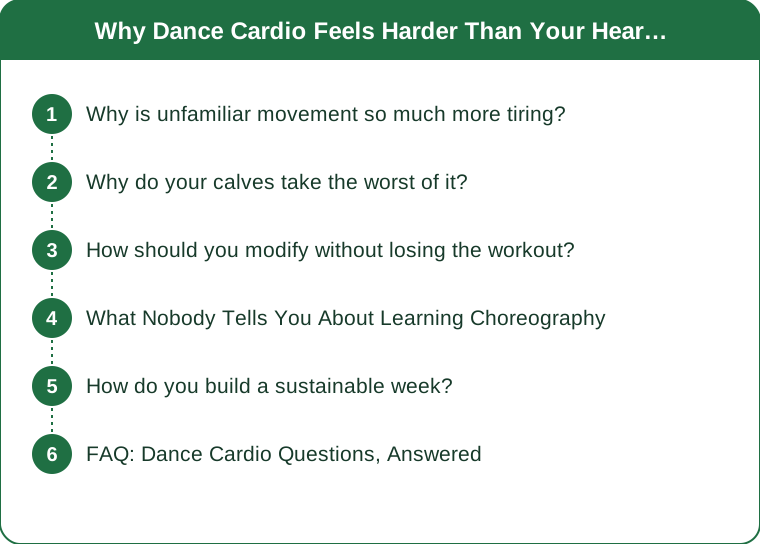
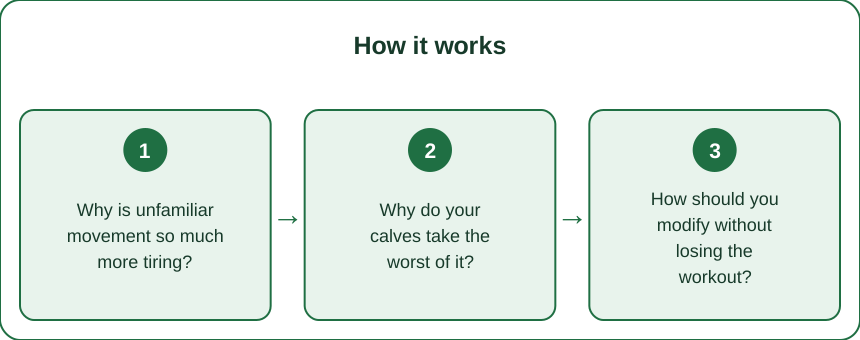
Why is unfamiliar movement so much more tiring?
Learning a movement recruits far more muscle than performing it does. Before the pattern is established, your nervous system co-contracts opposing muscles to stabilise a movement it does not yet trust, which costs energy without producing motion.
Skilled movement is efficient movement, and efficiency in this context means switching muscles off at the right moments. That switching-off is what practice actually builds.
Cognitive load has a metabolic cost too. Watching, remembering and predicting choreography is real work, and it is why a routine you know feels lighter than a new one at identical intensity.
Direction changes are disproportionately expensive. Every turn, pivot and level change requires deceleration and reacceleration, which costs far more than steady-state motion at the same average speed.
Heart rate is a poor measure of this kind of effort, because coordination load and muscular tension do not raise heart rate the way sustained aerobic work does. Your watch is not wrong; it is measuring a different thing.
And anticipation is what changes. Once you know the routine, you begin moving before the cue rather than after it, which removes the constant catching-up that makes learning so tiring.
Why do your calves take the worst of it?
Most dance cardio is performed on the forefoot, with heels rarely reaching the floor. That is a sustained calf contraction for forty minutes.
Everyday walking uses the calf briefly and cyclically, with a full lengthening every stride. Dance removes that release, which is the actual difference.
Bouncing and small jumps add repeated eccentric loading, and eccentric work is what produces delayed-onset soreness.
The soreness peaks 24 to 48 hours later, so the class that felt manageable produces the worst day two.
Heels down whenever the choreography permits is the single most useful adjustment, and instructors generally allow it - low-impact variations exist for exactly this.
Calf raises and eccentric heel lowers off a step, two to three times a week, build tolerance faster than dancing more does.
And shoes matter here more than anywhere else in fitness. Cushioned trainers with a slight heel drop reduce calf load meaningfully compared with flat or minimal shoes.
How should you modify without losing the workout?
Keep the arms and shrink the legs. Upper-body movement drives a surprising amount of the heart rate response, so full arms with stepped-down footwork preserves most of the intensity at a fraction of the impact.
Step instead of jump, every time. A step-touch replaces a jump in nearly every routine and the cardiovascular difference is small.
Take the lower level of any level change. Deep squats and floor work are the most joint-demanding elements and the easiest to scale.
Cut the range before you cut the tempo, since staying on the beat matters more for the experience than reaching the full extension does.
Learn the footwork first and add arms second, which is how instructors teach anyway and how you should practise when reviewing at home.
Use the back row deliberately. It gives you sight lines to several dancers rather than only the instructor, and seeing multiple interpretations of a move genuinely accelerates learning.
And a supportive high-impact bra changes the experience more than any other equipment decision in this format specifically, because of the sustained vertical movement.

What Nobody Tells You About Learning Choreography
Repeating one routine beats trying many. Variety feels productive and it prevents the efficiency gains that make dance enjoyable. Pick two or three routines and run them for a month.
Week four is where it changes. Almost everyone reports the same arc - unmanageable for three weeks, then suddenly fun. People who quit almost all quit before that.
Mirrors help some people and derail others. If watching yourself pulls you out of the movement, look at the instructor instead. Neither approach is more correct.
Your first attempt at any move will be too big. Beginners over-extend because they are copying shape rather than feeling timing. Smaller and on-beat beats bigger and late.
Marking - running the routine at half size while walking through it - is what professionals do and it is the most efficient home practice there is. Five minutes of marking beats twenty of full-out repetition.
Music familiarity does a lot of work. A routine set to a song you know is easier to learn, because half the anticipation problem is already solved.
And the people who look effortless in class are almost all repeating a routine they have done a dozen times. You are comparing your week one to their week twelve, which is not a comparison at all.
How do you build a sustainable week?
Two to three dance sessions a week is plenty for a beginner, with at least one day between them.
Twenty to thirty minutes is a real session. The hour-long class is not the entry point and treating it as one is how people burn out in week two.
Alternate with walking on the off days, which maintains cardiovascular work while the calves recover.
Add two calf sessions a week, which is the highest-value supplementary work for this format specifically.
Warm up the ankles and calves before dancing - circles, heel raises and a two-minute march. Cold calves in a forefoot-heavy class is the injury pattern to avoid.
Track how the routine feels rather than how hard it was. Feeling like you know it is the metric that predicts continuing, and it improves faster than fitness does.
And give it four weeks before deciding whether you like it. Almost nobody enjoys dance cardio in week one, and a large majority enjoy it by week five. This is general information, not medical advice.
FAQ: Dance Cardio Questions, Answered
Why is my heart rate low if the class feels so hard?
Because coordination and muscular tension load your nervous system and muscles without raising heart rate the way steady aerobic work does. Perceived effort and heart rate genuinely diverge in skill-heavy formats.
How long until choreography stops feeling impossible?
Most people report a clear shift around week four, provided they repeat the same routines rather than doing a different one each session.
Is dance cardio enough on its own?
It is genuinely good cardiovascular work. Add two resistance sessions a week for bone and muscle, since dance does relatively little for maximum strength.
Do I need dance shoes?
Not for home or most fitness classes. Cushioned trainers with a slight heel drop work well; avoid flat or minimal shoes given how much forefoot work is involved.
Why do my calves hurt so much more than everything else?
Because dance keeps you on the forefoot with a sustained calf contraction that walking never produces, plus repeated eccentric loading from bounces. It settles within a few weeks.
Should I stand at the front or the back?
The back is often better for learning, because you can see several dancers at once. Front-row visibility of the instructor matters less than most beginners assume.
TL;DR:
- Dance cardio loads the nervous system as much as the cardiovascular one, so effort and heart rate diverge early on.
- Learning a movement recruits far more muscle than performing it, which is why unfamiliar routines are so expensive.
- Repeat two or three routines rather than chasing variety - efficiency is the entire point.
- Calves take the worst of it because you stay on the forefoot; add calf work and wear cushioned shoes.
- Modify by keeping the arms and shrinking the legs, which preserves most of the intensity.
- Week four is where it turns fun, and nearly everyone who quits, quits before it.
Give it four weeks before deciding. This is general information, not medical advice.
Keep Reading
This article is for general informational and styling purposes only. Fit, sizing, and product availability may vary.
