Why Is Dance Cardio Hardest in the Third Minute?
Quick Answer: In the first couple of minutes of hard activity, your aerobic system has not fully engaged, so you are running largely on anaerobic energy and accumulating fatigue quickly. Around the two to four minute mark this feels worst — heart rate is climbing, breathing is catching up, and the aerobic system is only just taking over. Push through it and it genuinely gets easier, which is the second wind people describe.
The warm-up was fine. Minute one was fine.
Minute three is where you consider stopping — and minute six is easier than minute three.
This is general information, not medical advice.

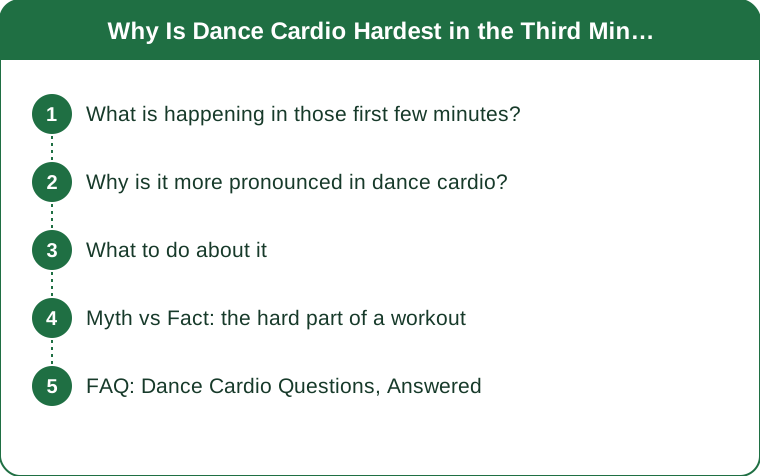
What is happening in those first few minutes?
Your body is switching energy systems, and the handover is not smooth.
At the start of any demanding activity, oxygen delivery lags behind oxygen demand. Your muscles start working immediately; heart rate, breathing rate, and blood flow redistribution take a couple of minutes to reach the level the work requires. That gap is called the oxygen deficit.
During the gap, energy comes largely from anaerobic sources — stored phosphocreatine and glycolysis. These deliver energy quickly and they are not sustainable, and they produce metabolic by-products that contribute to the burning, heavy sensation in working muscles.
So the sequence is:
- Minute one: stored energy covers the demand. Feels manageable.
- Minutes two to four: stored energy is depleting, aerobic delivery is still ramping up, by-products are accumulating. This is the worst point.
- Minute five onward: aerobic metabolism is meeting the demand, by-products are being cleared as fast as they are produced, and a steady state is reached. It genuinely feels easier.
That improvement is real physiology rather than mental toughness. The work has not become lighter; your system has finally caught up with it.
Does this happen in every kind of exercise?
Yes — running, cycling, swimming, and rowing all produce it. It is particularly noticeable in dance cardio because classes typically jump to full intensity quickly, without the gradual build that structured cardio often has.
Why is it more pronounced in dance cardio?
Several features of the format sharpen the effect.
Intensity arrives abruptly. A dance class typically moves from a light warm-up into a full-intensity track quickly. A running warm-up eases in over several minutes; a dance track does not.
The whole body is working. Arms, legs, and trunk together demand more total oxygen than a lower-body-dominant activity at similar perceived effort, which makes the deficit larger.
Intensity fluctuates constantly. Dance choreography varies effort continuously rather than holding a steady output. Every intensity spike creates a small new deficit, so the system never fully settles the way it does in steady running.
You are learning while working. Cognitive load — following the choreography, watching the instructor, remembering the sequence — adds to perceived effort. In a first class this is substantial, and it lands during exactly the minutes that are already hardest.
The arms are overhead a lot. Working with arms raised above the head raises heart rate and perceived effort more than the same effort with arms down. Dance uses overhead positions frequently and it contributes more than people expect.
Does this mean the class is badly designed?
Not at all. Varying intensity is what makes dance cardio effective. It just means the first few minutes deserve a different strategy than the rest of the class.

What to do about it
1. Warm up before the warm-up. The most effective solution. Three to five minutes of easy movement — marching, walking, gentle arm circles — before the class starts allows the aerobic system to begin ramping up before the demand arrives. The oxygen deficit is much smaller when you enter the first track already warm.
This is standard practice for endurance athletes and rarely mentioned in dance cardio. It changes the experience of the first ten minutes considerably.
2. Take the first track at reduced intensity deliberately. Half the arm movements, smaller steps, no jumping. Not a modification because you cannot manage — a deliberate build. Then raise intensity from track two onward, when your system is ready to support it.
3. Know that minute three is the peak difficulty and not the trend. Simply knowing that it improves changes how it feels, because much of what makes the third minute hard is the belief that it will keep getting worse for another forty minutes. It will not.
4. Keep moving rather than stopping completely. If you need to reduce, march on the spot instead of standing still. Stopping abruptly means restarting the whole process, and the second climb through the deficit is harder than the first.
5. Use the arms as your throttle. Lowering the arms is the fastest way to reduce intensity while staying with the choreography, and raising them again is the fastest way to increase it. This is more useful than trying to change the footwork.
6. Expect it to shrink with fitness. As aerobic fitness improves, the system responds faster and the deficit is smaller. The third-minute wall becomes noticeably less dramatic within a few weeks of regular training, which is one of the more encouraging early signs of progress.
Should I be worried if it feels really hard?
Effort that peaks early and then eases is a normal pattern. Chest pain, dizziness, or breathlessness that is out of proportion or does not settle is different and worth stopping for and discussing with a doctor.
Myth vs Fact: the hard part of a workout
Myth: If the start is hard, the rest will be harder. Fact: The opposite is usually true for continuous cardio. The early minutes are the transition; once aerobic metabolism catches up, the same work feels easier.
Myth: Needing to reduce intensity early means you are unfit. Fact: Everyone experiences the oxygen deficit, including trained athletes — they simply move through it faster. Building into the first track is what experienced people do deliberately.
Myth: A warm-up is optional if the class starts gently. Fact: Most class warm-ups are shorter and more intense than a true aerobic warm-up. A few minutes of easy movement beforehand does something a choreographed warm-up often does not.
Myth: The second wind is psychological. Fact: It corresponds to a genuine physiological transition as aerobic metabolism meets demand and by-product clearance catches up with production.
Myth: Stopping to rest is the best way to recover mid-class. Fact: Active recovery — marching, walking, moving gently — clears metabolic by-products faster than standing still, and it keeps the aerobic system engaged so restarting is easier.
Myth: You should be able to do the full intensity from the first track. Fact: Instructors build classes assuming people scale. Doing track one at 60 percent and tracks two to eight at full effort produces a better session than doing track one at 100 percent and struggling for the rest.
FAQ: Dance Cardio Questions, Answered
How long does the difficult phase last?
Typically somewhere in the two to five minute range for most people, with better-trained individuals moving through it faster. It shortens noticeably with a few weeks of consistent training.
Is it worse in the morning?
Many people find morning sessions have a longer transition, since body temperature is lower and the cardiovascular system takes longer to respond. A slightly longer warm-up helps more in the morning than at any other time.
Does it get worse in cold weather?
Yes — cold muscles and a cold room both lengthen the process. From autumn onward, a longer warm-up is more important than in summer.
What if I never get the second wind?
If the session is at an intensity above what your aerobic system can sustain, you will not reach a steady state. That means the intensity is too high for the duration, and reducing it slightly is the fix rather than pushing harder.
Should I eat before dance cardio?
A small snack an hour or so before helps many people, particularly for morning sessions. Large meals shortly before tend not to work well with jumping and rotation.
Is dance cardio enough on its own?
It is genuinely good cardiovascular exercise. Most guidance also recommends some resistance training for muscle and bone health, which dance does not fully cover.
TL;DR:
- The first minutes run on anaerobic energy while oxygen delivery catches up, creating an oxygen deficit.
- Difficulty peaks around minutes two to four and then genuinely eases as aerobic metabolism takes over.
- Dance cardio sharpens the effect: abrupt intensity, full-body work, overhead arms, and cognitive load.
- Warm up for three to five minutes before the class, and take the first track deliberately easier.
- Reduce by lowering the arms rather than stopping, and keep moving during recovery.
Minute three is not where you find out whether you can do the class. It is the gear change, and minute six is easier.
This is general information, not medical advice.
Keep Reading
This article is for general informational and styling purposes only. Fit, sizing, and product availability may vary.