Why a Dance Cardio Class Can Feel Harder on Some Days at the Exact Same Intensity
Quick Answer: A dance cardio class feeling harder on some days despite identical choreography and pace usually reflects real, measurable day-to-day variation in sleep quality, hydration status, and blood sugar stability rather than the workout itself changing — meaning the difficulty difference is genuine, not a mental or motivational failing on harder days.
The steps didn’t change. The music didn’t change. And yet the class felt noticeably harder — that gap is usually explained by what happened before class, not during it.

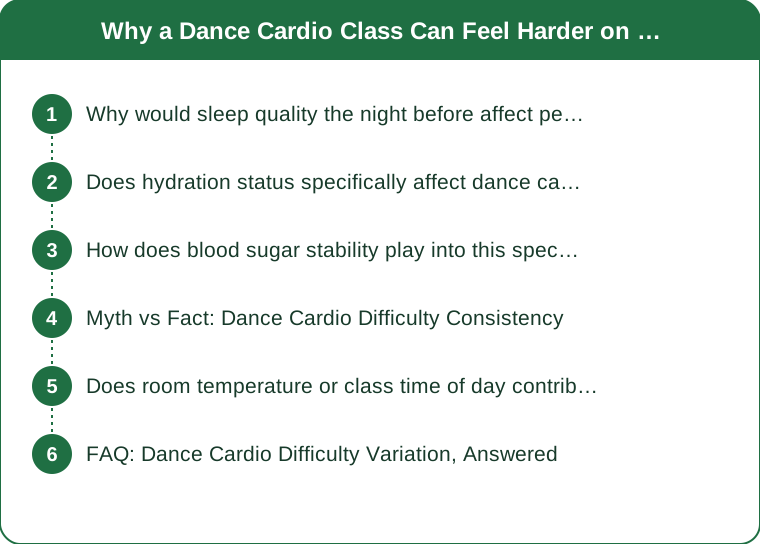
Why would sleep quality the night before affect perceived difficulty this much for the same routine?
Poor or shortened sleep measurably reduces both physical coordination and perceived energy availability the following day, meaning identical choreography requires more conscious effort to execute at the same pace, which directly translates into a class feeling harder even though the actual movement demands haven’t changed at all.
Does hydration status specifically affect dance cardio more than other workout types?
Dance cardio’s continuous, rhythm-paced movement pattern doesn’t allow for the same natural pacing breaks a strength workout’s rest periods provide, meaning even mild dehydration’s effects on energy and coordination show up more noticeably and immediately during a sustained cardio class than they might during a workout with built-in rest.
How does blood sugar stability play into this specific day-to-day difficulty variation?
A class taken on an empty stomach, or several hours after a carbohydrate-heavy meal that’s since caused a blood sugar dip, can feel measurably harder than the same class taken with more stable blood sugar, since sustained rhythmic movement relies heavily on consistent glucose availability for working muscles.

Myth vs Fact: Dance Cardio Difficulty Consistency
Myth: if a familiar routine feels harder than usual, fitness level must be declining. Fact: day-to-day physiological variation (sleep, hydration, blood sugar) is a well-documented, normal cause of perceived difficulty fluctuation, and a single harder class says very little about actual fitness trend, which is better judged over weeks.
Does room temperature or class time of day contribute meaningfully to this variation too?
Yes — a warmer, more crowded room raises core body temperature faster during continuous movement, and classes taken very early or very late relative to a person’s own natural energy rhythm can also feel harder independent of any change in the choreography or pace itself.
FAQ: Dance Cardio Difficulty Variation, Answered
Is it worth skipping a class entirely on a day predicted to feel harder?
Not necessarily — showing up and simply allowing the intensity to be whatever it is that day, rather than expecting to match a previous best class, tends to work better than skipping based on anticipated difficulty alone.
Does eating right before a dance cardio class help or worsen this variation?
A small, easily digestible snack with some carbohydrate roughly 30-60 minutes before class tends to support more stable energy through the class than eating too close to start time or skipping food entirely.
Should difficulty be tracked over time to distinguish normal variation from an actual fitness change?
Yes — tracking general trends (how classes feel on average over several weeks) is a more reliable way to assess real fitness progress than judging any single class’s difficulty in isolation.
TL;DR:
- Real day-to-day variation in sleep, hydration, and blood sugar explains most unexpected difficulty swings in a familiar class
- Dance cardio’s continuous movement pattern makes these factors show up more immediately than in workouts with built-in rest
- A single harder class reflects that day’s physiology, not a decline in actual fitness or effort
- Judging fitness trends over several weeks, not any single class, gives a far more accurate picture
Next time a familiar class feels unexpectedly hard, check sleep and food from earlier that day before assuming anything about fitness — the two are usually connected.
Keep Reading
This article is for general informational and styling purposes only. Fit, sizing, and product availability may vary.
