Why a Sports Bra Fails in Dance Cardio Before It Fails in Running
Quick Answer: Running is mostly vertical, repetitive motion, and most sports bras are engineered specifically for that. Dance cardio adds lateral movement, rotation, sudden direction changes, and overhead arm work - four demands that load the bra in directions its compression and strap geometry were never designed to handle. That is why a bra that is perfect for running rides up, gapes, digs, or shifts within ten minutes of a dance class.
Here is what actually fails, and what to look for instead.

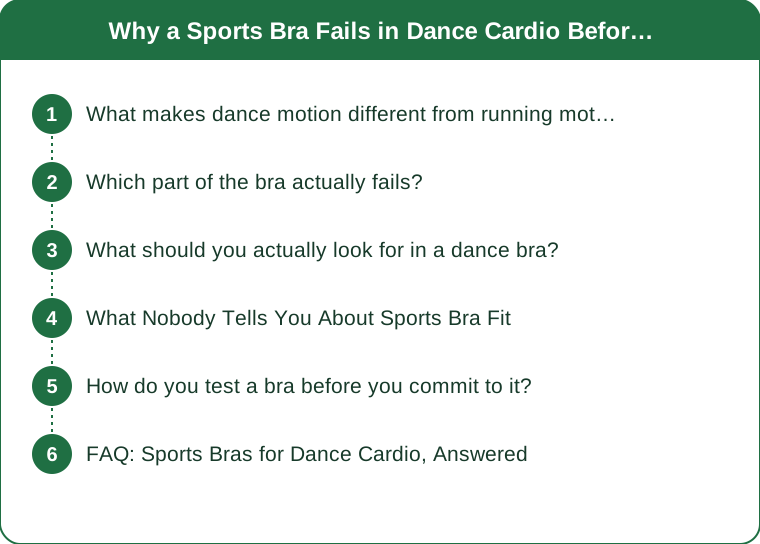
What makes dance motion different from running motion?
Four things, and they compound.
Running is predictable and mostly vertical. Breast motion during running follows a repeating figure-of-eight dominated by the vertical axis. Bra engineering has optimised around this for decades - compression, encapsulation, and strap tension all target vertical displacement.
Dance is multidirectional and unpredictable. Side steps, hip movement, rotation through the torso, sudden stops. Lateral and rotational displacement are much larger shares of the total movement - and lateral motion is exactly what a compression bra handles least well.
Arms go overhead constantly. This is the underrated one. Raising your arms lifts the entire bra band if the straps are attached in a way that transmits arm movement to the band. A bra that fits perfectly with arms down can ride up two inches with arms up - and it does not come back down on its own.
Direction changes create acceleration spikes. A change of direction produces a brief force much higher than steady-state running, in a direction the bra is not braced for. The band is the structure that resists this, and a band that is even slightly loose loses immediately.
And it happens without warning. Running builds up gradually. Dance choreography can go from a step-touch to a full turn in one beat, giving no time for anything to settle.
Which part of the bra actually fails?
Almost always the band, and almost never the part people blame.
The band carries the majority of the support. Commonly cited figures put it at around 80 percent, with straps handling the rest. A loose band transfers that load to the straps, which is why shoulder digging is nearly always a band problem, not a strap problem.
Riding up is a band problem. If the band moves up during overhead work and stays there, it is too loose or too soft to anchor. A firm band under the bust does not travel.
Gaping at the top of the cup is a shape and cup-size problem. Common in encapsulation bras where the cup volume is too large for the fill, and it gets much worse in forward-leaning movements which dance has plenty of.
Straps slipping off the shoulder is a strap-geometry problem. Standard vertical straps sit at an angle that arm movement pushes outward. Racerback and cross-back designs solve this by pulling the strap toward the midline, which is precisely why dance and studio-class bras so often use them.
Chafing under the band or at the underarm is a seam-and-fabric problem, and it shows up faster in dance because the movement is more varied and the sweat pattern is different. A seam that never bothered you running can rub raw in an hour of lateral movement.
And the failure that people misdiagnose most: ‘the bra stretched out’. Usually the band was already at the loosest hook, or the bra is simply old. Elastic degrades - most sports bras have a functional life of roughly 6 to 12 months of regular use, and heat from a tumble dryer shortens it substantially.
What should you actually look for in a dance bra?
The features that address the four demands above.
A genuinely firm band, and check it in the position that fails. Put the bra on, raise both arms overhead, and see whether the band moves. If it rides up and stays up, it is not the bra for dance - and this 10-second test in a fitting room prevents most disappointments.
Racerback or cross-back straps. They resist slipping, and they keep arm movement from lifting the band as directly as vertical straps do. For overhead-heavy classes this is close to non-negotiable.
Encapsulation, not compression alone, for larger busts. Compression flattens against the chest and handles vertical motion adequately, but it does much less for lateral movement. Encapsulation - separate structured cups - controls each side independently, which is what multidirectional movement needs. Combination bras that do both are generally the best option for dance.
Wide, cushioned band and straps. Load spread over more surface area means less digging - which matters more when the load is being applied unpredictably.
Adjustable straps and a hook-and-eye closure. Adjustability lets you tune the fit as the bra ages, and a hook closure allows a firmer band than a pull-on design usually achieves. It also makes the bra vastly easier to get off when you are sweaty - a practical point nobody mentions until they have been stuck in one.
Flat or bonded seams in the underarm area. This is where dance chafes and running does not.
And moisture-moving fabric with genuine ventilation. Studio classes are warm, the movement is continuous, and a bra that holds sweat against the skin under the band is the fastest route to chafing.

What Nobody Tells You About Sports Bra Fit
Most people are wearing a band too loose and a cup too small. It is the most common sizing error in bras generally and it is magnified in sport. The band should be firm enough that you can just slide two fingers under it and no more.
Your sports bra size is not automatically your everyday bra size. Different construction, different brands, different intent. Sizing has to be checked per bra, which is inconvenient and true.
Size changes with more than weight. Cycle phase, water retention, temperature, and training changes all shift fit week to week. A bra that fits perfectly one week and digs the next is normal, not a defect - which is a strong argument for adjustable straps and multiple hook positions.
Start on the loosest hook. A new bra should fit on the outermost hook so you can tighten it as the elastic relaxes. Buying a bra that only fits on the tightest hook means it has a very short usable life.
Two bras rotated last longer than one bra worn twice as often. Elastic needs time to recover its shape. Rotating genuinely extends the life of both, which offsets the cost of buying two.
And the care instructions matter more than they sound. Heat destroys elastane. Wash cool, and never tumble dry a sports bra - the dryer is the single fastest way to turn a supportive bra into a loose one. Air drying costs nothing and roughly doubles the useful life.
The one that surprises people: replacing a worn-out bra often fixes ‘problems’ people have blamed on themselves for months - the digging, the riding up, the discomfort. If it is over a year old and worn regularly, test it against a new one before concluding anything about fit.
How do you test a bra before you commit to it?
A five-minute routine in the fitting room that predicts the class.
1. Check the band with arms down. Two fingers under it, no more. If you can pull it far from your back, the band is too loose regardless of how the cups feel.
2. Raise both arms straight overhead and hold. Does the band ride up? Does it come back down when you lower your arms? This single test eliminates most bras that fail in dance.
3. Do a few side steps and a torso rotation. Feel for shifting, gaping, or the cups moving independently of you. Lateral motion is the demand running never tests.
4. Jump five times. Yes, in the fitting room. Vertical control is still necessary - dance has plenty of it, and a bra that fails here fails everywhere.
5. Check the straps at the shoulder. They should sit flat and not dig. Digging with arms down means the band is doing too little work.
6. Look for gaping at the top of the cup while leaning forward. Dance involves more forward positions than running. Gaping in a forward lean means the cup does not match your shape, and no strap adjustment fixes it.
7. Check the seams against your skin at the underarm. Run a finger along them. Anything you can feel clearly at rest will be noticeable after 30 minutes of movement.
If you experience pain, persistent chafing that breaks the skin, or discomfort that a well-fitting bra does not resolve, it is worth speaking to a professional bra fitter or a healthcare provider. This is general information, not medical advice.
FAQ: Sports Bras for Dance Cardio, Answered
Why does my running bra ride up in dance class?
Overhead arm movement lifts the band, especially with vertical straps. Running rarely puts your arms overhead, so the failure never shows up there. A racerback or cross-back design with a firmer band solves it.
Compression or encapsulation for dance?
Encapsulation, or a combination bra, particularly for larger busts. Compression handles vertical motion reasonably but does much less for the lateral and rotational movement that dance is full of.
Shoulders are digging - do I need wider straps?
Usually not. Digging almost always means the band is too loose, so the straps are carrying load they were not designed for. Tighten or size down the band first.
How often should I replace a sports bra?
Roughly every 6 to 12 months with regular use, sooner if the band has lost its firmness or you are already on the tightest hook. Tumble drying shortens that considerably.
Should a new bra fit on the tightest hook?
No, the loosest. That leaves room to tighten as the elastic relaxes over months of wear. A bra that only fits on the tightest hook is already near the end of its useful life.
Is it normal for fit to change week to week?
Yes. Cycle phase, water retention, and temperature all shift fit. Adjustable straps and multiple hook positions are what make a bra usable across those changes.
TL;DR:
- Running is mostly vertical and predictable; dance adds lateral movement, rotation, direction changes, and overhead arm work.
- Overhead arms lift the band - the single most common reason a good running bra fails in a dance class.
- The band carries roughly 80 percent of the support. Shoulder digging and riding up are band problems, not strap problems.
- Look for a firm band, racerback or cross-back straps, encapsulation or combination construction, wide padded straps, and a hook closure.
- Test it with arms overhead in the fitting room - 10 seconds that predicts the whole class.
- Buy so it fits on the loosest hook, rotate two bras, wash cool and never tumble dry.
- Most sports bras last 6 to 12 months of regular use - an old bra explains a lot of ‘fit problems’.
The bra did not get worse. The movement got more complicated.
This is general information, not medical advice.
See It in Motion
Seen here: Racerback Tank Top - White — shop similar styles on bubblelime.com
Keep Reading
This article is for general informational and styling purposes only. Fit, sizing, and product availability may vary.