Why Choreography Speed Matters More Than Difficulty When Choosing a Dance Cardio Class
Quick Answer: Choreography complexity and choreography speed are two separate variables, and a class with genuinely simple steps taught at a fast tempo can feel far harder to follow than a moderately complex routine taught slowly with clear count-outs — when picking a class, asking about teaching pace and whether steps are broken down before full-speed run-throughs matters more than asking how ‘easy’ the choreography itself is.
A class advertised as beginner-friendly can still move too fast to actually follow, which is a pacing problem, not a difficulty problem.
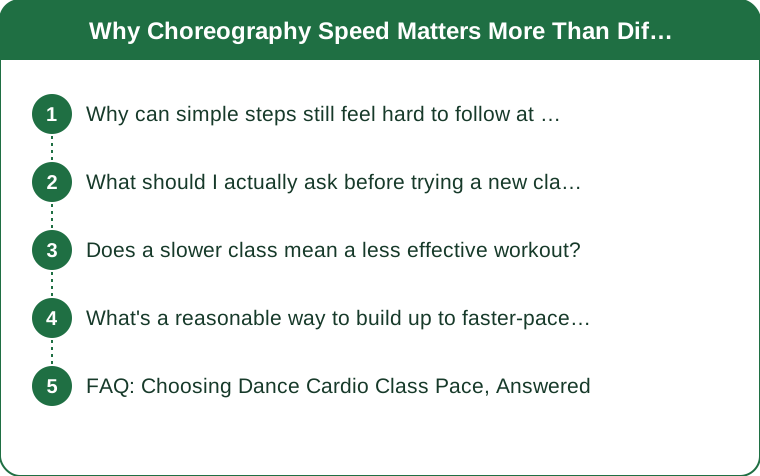
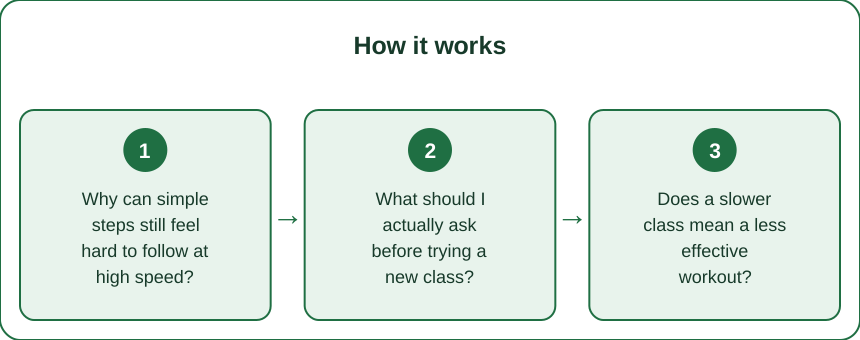
Why can simple steps still feel hard to follow at high speed?
Fast tempo compresses the time available to process each cue and transition, so even genuinely simple steps become hard to execute smoothly if there isn’t enough time between them to register the next move, independent of how complex the steps themselves are.
What should I actually ask before trying a new class?
Ask whether the instructor breaks down choreography step-by-step before running it at full speed, and whether modifications or a slower-paced option are offered during faster sections — these questions get at pacing directly, rather than relying on a vague ‘beginner-friendly’ label.

Does a slower class mean a less effective workout?
No — a well-taught, moderately-paced class that you can follow accurately delivers more consistent cardio benefit than a fast class where you’re frequently lost and standing still trying to catch up, since consistent movement matters more for cardio output than raw speed.
What’s a reasonable way to build up to faster-paced classes over time?
Attending the same class repeatedly lets you memorize choreography patterns, which naturally makes faster pacing easier to follow even before your actual dance skill improves — familiarity, not just skill, drives a lot of the improvement.
FAQ: Choosing Dance Cardio Class Pace, Answered
Is it okay to ask an instructor to slow down mid-class?
Most instructors welcome this feedback, and it’s a completely reasonable request, especially in a smaller class setting.
Do online or app-based classes let you control pacing better than in-person ones?
Yes, many offer pause and rewind functionality, which can make them easier to learn from at your own pace before attending in-person classes.
Should I avoid classes labeled ‘advanced’ entirely as a beginner?
Not necessarily forever, but starting with clearly beginner or all-levels classes first lets you build the pattern-recognition skills that make faster classes more approachable later.
TL;DR:
- Choreography speed and complexity are separate factors that affect how hard a class feels
- Simple steps at high speed can be harder to follow than complex steps taught slowly
- Ask about teaching pace and step breakdowns before judging a class by difficulty alone
- Repeated attendance builds familiarity that makes faster pacing easier over time
Keep Reading
This article is for general informational and styling purposes only. Fit, sizing, and product availability may vary.
