Why Learning Choreography Slowly Is Faster Than Learning It at Speed
Quick Answer: Motor learning depends on accurate repetition, and movements practiced at a speed beyond your current control are encoded with the errors included. Practicing at roughly half speed lets you encode the correct pattern, which then transfers to full speed within a few repetitions. Trying to keep up from the first run-through means learning an approximate version and then having to unlearn it, which takes considerably longer than starting slow.
The uncomfortable part is that slow practice looks like falling behind. For the first ten minutes it is, and then it is not.

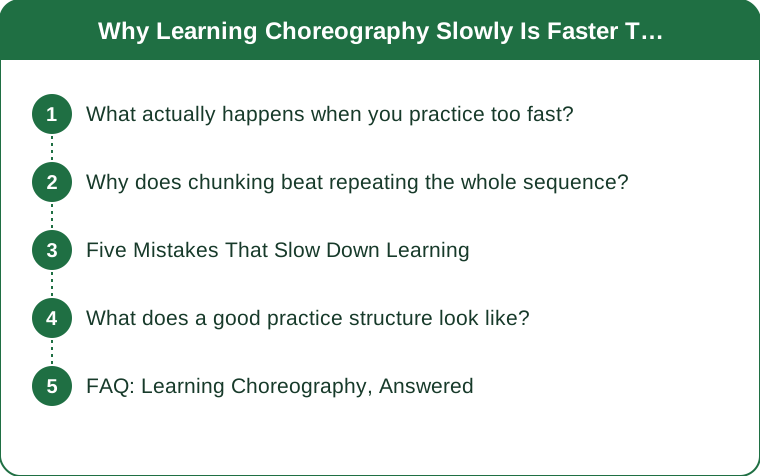
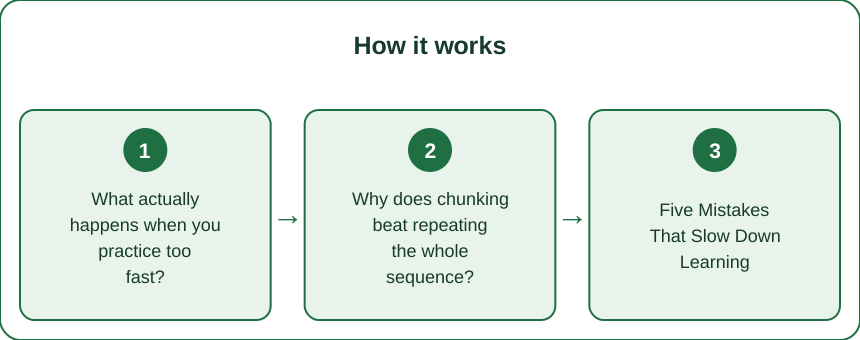
What actually happens when you practice too fast?
You learn something, just not the thing you intended.
Motor learning works by strengthening the specific neural pattern you repeat. It does not distinguish between a correct repetition and an incorrect one — it strengthens whatever you actually did.
When you attempt choreography above your current control threshold, what you actually do is an approximation: the arm goes roughly there, the weight shift happens roughly then, and the timing is roughly right. Repeat that eight times and you have consolidated the approximation.
Unlearning is genuinely harder than learning. The original pattern does not disappear; a competing one has to be built alongside it and made stronger. This is why a movement you learned wrong in week one can still surface under pressure in week six.
Slow practice avoids the whole problem. At half speed you have time to place the weight correctly, complete the arm path, and hit the timing — so the pattern being consolidated is the correct one.
The transfer to full speed is faster than people expect. A pattern learned accurately at half speed typically reaches full speed within three to five repetitions, because only the timing has to change, not the movement itself.
Why does chunking beat repeating the whole sequence?
Because working memory has a hard limit and choreography exceeds it immediately.
Most people can hold roughly four to seven independent items in working memory. A 32-count sequence contains far more than that in individual movements. Attempting to hold the whole thing at once guarantees that most of it is lost.
Chunking works by converting several movements into a single remembered unit. Once step-touch-turn-arms becomes one thing rather than four, it occupies one slot instead of four, and you can hold seven of those chunks.
The practical method: learn 8 counts until you can do them without thinking, then the next 8, then join them. The join is its own skill — the transition between two chunks is where most people break down, and it needs its own practice.
This is also why sequences fall apart in the middle rather than at the start or end. The start is well-rehearsed and the end is recent; the middle has neither advantage.
A useful trick: practice starting from count 17 rather than count 1. If you can only ever begin at the beginning, you have learned a chain rather than a sequence — and a chain breaks completely when one link fails.

Five Mistakes That Slow Down Learning
Watching the instructor’s feet. Most people look down at the feet, which means they see the movement from a difficult angle and miss the upper body entirely. Watch the whole body, and use peripheral vision for the feet.
Mirroring without adjusting. When facing the instructor, their right is your left. Some people mirror automatically; many do not, and spend a class confused. If you struggle with this, stand behind someone competent and copy them directly instead.
Marking too early. Marking — doing a small, low-energy version — is a professional technique for conserving energy while rehearsing. Used before the movement is learned, it means you are practicing a version with none of the actual weight shifts, which is where the difficulty lives.
Practicing only in the mirror. The mirror is useful for checking shape and useless for developing the internal sense of where your body is. Alternate: learn facing the mirror, then run it facing away. Anything that falls apart facing away was being read rather than remembered.
Stopping when you make a mistake. Stopping teaches your body that a mistake ends the sequence. Keep going and rejoin — recovery is a skill, and in any real performance context it matters more than accuracy.
What does a good practice structure look like?
Short, frequent, and slow at the start.
Learn at 50 percent speed. Explicitly. If the class moves faster, do the slow version in the back and let the count go past you. You will catch up on the third run-through and be ahead by the fifth.
Work in 8-count chunks and overlearn each one. Overlearning means continuing to repeat after you can do it correctly. That extra repetition is what makes it survive under the pressure of a full run.
Practice transitions separately. Take the last two counts of one chunk and the first two of the next, and run just those four. This is the highest-value drill available and nobody does it.
Space your practice. Three ten-minute sessions across a week produce far better retention than a single thirty-minute session. Sleep between sessions genuinely consolidates motor learning — the gains show up the next day without further practice.
Run it once at full speed at the end, then stop. Ending on a full-speed attempt gives you a sense of the target and a clean stopping point. Running it into the ground when you are tired reintroduces the errors you spent the session removing.
And allow that some things simply need more exposures than others. Turns, direction changes, and anything requiring a weight shift onto a single leg are consistently the slowest to learn, for everyone, regardless of experience.
FAQ: Learning Choreography, Answered
How many repetitions does a sequence usually take?
Highly variable, but a rough guide is 15 to 20 accurate repetitions before an 8-count feels automatic. Most classes provide about six, which is why practice outside class produces such a visible difference.
Should I record the class?
If permitted, yes — it is the single most useful learning aid. Watching a recording at half speed at home is exactly the slow practice described above, with the reference right there.
Why can I do it in class and not at home?
Usually because you were following rather than remembering. Following the person in front is a legitimate way to get through a class and it does not build memory. Running the sequence facing away from everyone is the test that distinguishes the two.
TL;DR:
- Movement practiced faster than your control encodes the errors, and unlearning is slower than learning.
- Practice at half speed; the transfer to full speed takes only three to five repetitions.
- Work in 8-count chunks, overlearn each, and drill the transitions between them separately.
- Three short spaced sessions beat one long one, and sleep consolidates the learning.
Next class, deliberately do the first two run-throughs at half speed while everyone else keeps up. Check where you are by run-through five.
Keep Reading
This article is for general informational and styling purposes only. Fit, sizing, and product availability may vary.