Why Low-Impact Dance Modifications Are Not Actually Easier
Quick Answer: Low-impact modifications remove the airborne phase, not the effort. Without the elastic energy return from landing, your muscles have to generate more of the movement actively — which is why a low-impact class often produces a higher heart rate and more muscular fatigue than the version with jumps.
You took the modification expecting a break. Twelve minutes later you’re more out of breath than the people jumping. That’s not a sign you’re unfit — it’s a fairly direct consequence of the physics you just opted into.

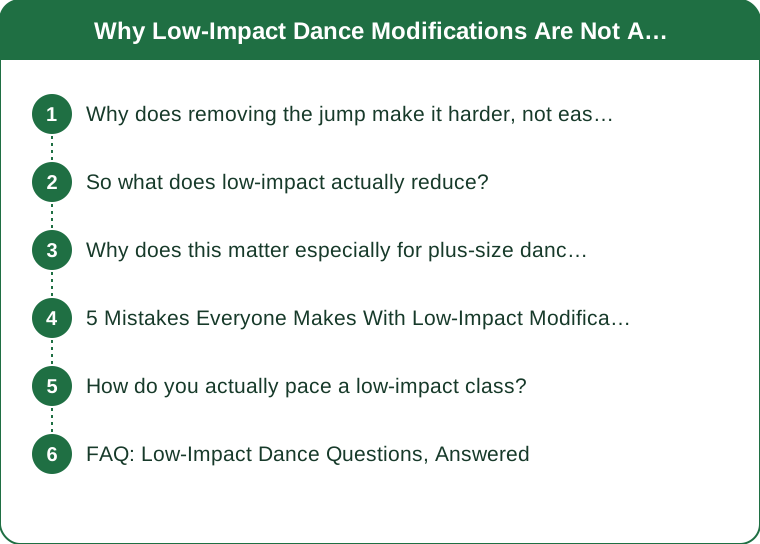
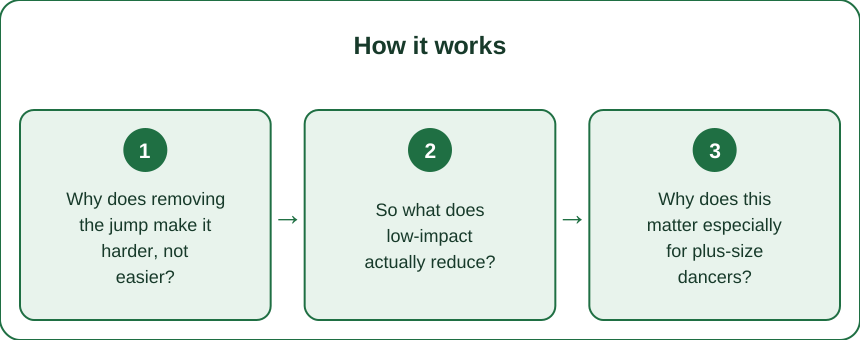
Why does removing the jump make it harder, not easier?
A jump stores and returns energy. Tendons and connective tissue load on landing and give a portion of that energy back on the next push-off, which is genuinely free work — your muscles don’t have to produce it.
Take away the landing and you take away the rebound. A low-impact grapevine or step-touch has to be powered almost entirely by active muscular contraction, with continuous tension instead of a load-and-release cycle. Continuous tension is metabolically expensive, which shows up immediately as a higher heart rate at what looks like a gentler movement.
So what does low-impact actually reduce?
Joint impact forces. That’s the trade, and it’s a real and valuable one — reduced peak loading through knees, hips, and ankles, and less stress on the pelvic floor.
It’s just not a reduction in cardiovascular or muscular demand. Low-impact means low-impact, not low-intensity — two words that got collapsed into one meaning somewhere along the way and have confused people ever since.
Why does this matter especially for plus-size dancers?
Two reasons. First, joint loading during impact scales with body weight, so the impact-reduction benefit is proportionally larger — that’s the case for choosing low-impact on its own merits, not as a fallback.
Second, the framing does damage. When modifications are presented as the easier option and then feel harder, the natural conclusion is I must be badly out of shape. The actual explanation is that you chose the version with more continuous muscular work. That reframe changes how the whole class feels.

5 Mistakes Everyone Makes With Low-Impact Modifications
Mistake 1: expecting a rest. Take the modification for joint protection, not for recovery. If you need recovery, march it out — that’s a different choice.
Mistake 2: adding depth to compensate for guilt. Sinking deeper into every move to feel like you’re working hard enough stacks quad fatigue fast and usually breaks form by minute 20.
Mistake 3: keeping the arms big the whole time. Full-range arms in every track is what most often ends a class early. Arms are the easiest dial to turn down.
Mistake 4: switching mid-track. Alternating between impact and low-impact versions of the same move disrupts rhythm and increases misstep risk. Pick one per track.
Mistake 5: never taking the low-impact option on purpose. The fifth one catches even experienced dancers — using it strategically on high-volume days is how people stay in dance long-term, not a step backward.
How do you actually pace a low-impact class?
Use effort, not appearance. A simple check: can you speak a short sentence? If not, drop the arms first, then reduce the range of the legs, and only then step out entirely.
Expect to be genuinely warm within ten minutes. Expect calves and glutes to fatigue sooner than in a jumping version, because they’re producing more of the work without the rebound. And expect the fatigue to land differently the next day — usually more muscular soreness, less joint achiness.
FAQ: Low-Impact Dance Questions, Answered
Do I burn fewer calories with low-impact modifications?
Not necessarily. Because low-impact versions require more continuous muscular work, energy expenditure is often comparable — and heart rate is frequently higher.
Should I ever do the jumping version?
That’s an individual call based on joints, comfort, and goals. Impact does have benefits for bone density, but there’s no requirement to jump to get a strong cardiovascular workout.
Why do my calves hurt so much more with low-impact?
Without the landing rebound, your calves work through a longer continuous contraction to control each step. That extra time under tension is exactly what produces the soreness.
TL;DR:
- Low-impact removes the elastic energy return, so muscles produce more of the work
- The trade is reduced joint loading, not reduced intensity
- Low-impact often produces a higher heart rate than the jumping version
- Manage effort by dialing back the arms first, then the leg range
- Choosing low-impact strategically is a long-term-participation tactic, not a step down
If the modification felt harder, the physics were on your side the whole time — you didn’t take the easy option, you took the joint-friendly one.
Keep Reading
This article is for general informational and styling purposes only. Fit, sizing, and product availability may vary.
