Why Mirrors Help Some Dancers in Class and Completely Derail Others
Quick Answer: Mirrors give useful feedback once you already know a movement, and interfere while you are still learning it, because watching yourself competes for the same attention you need to process the choreography. They also shift focus from how the movement feels to how it looks, which is genuinely unhelpful early on and a specific source of self-consciousness for many people. The practical answer is to learn facing away or with a soft gaze, and use the mirror deliberately for checking a movement you already have.
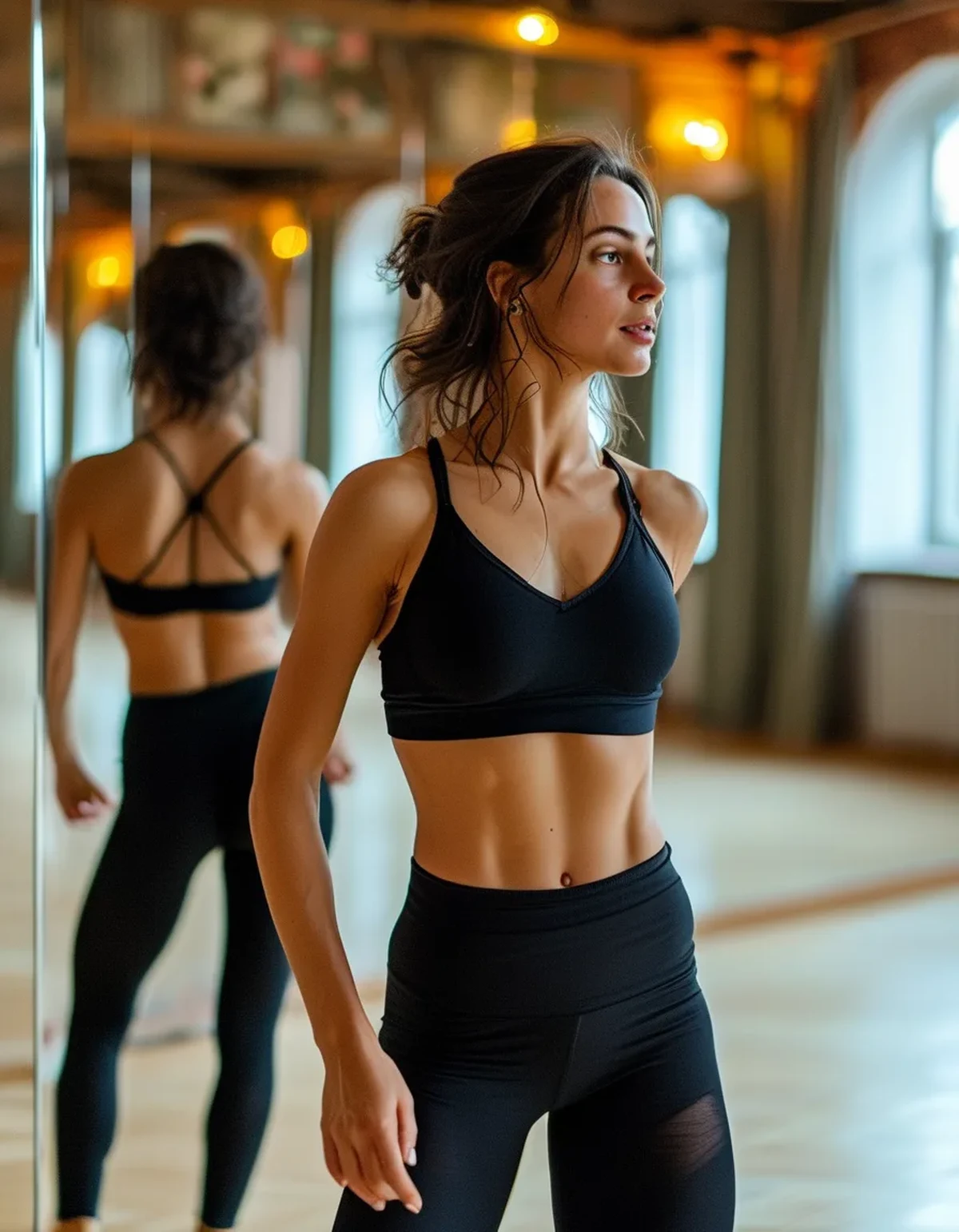
Some people in the class are watching themselves intently and clearly benefiting. You look up, catch your own reflection, and lose the count entirely.
This blog has covered why the back row is actually the best place to learn choreography and how intimidation shapes which classes people choose. The mirror is the specific piece of studio equipment that produces the widest range of reactions, and there is a reasonable explanation for it.
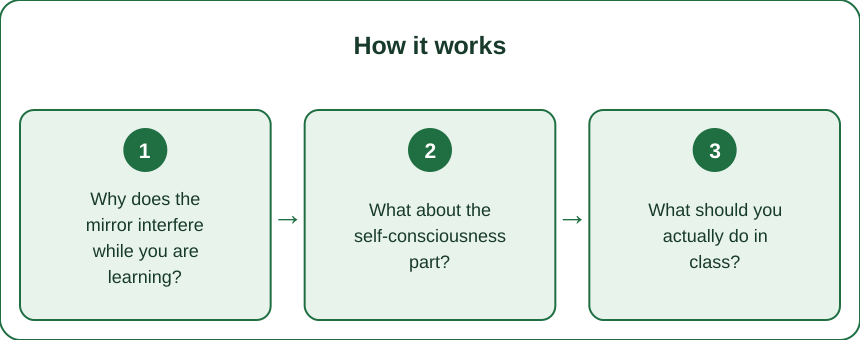
Why does the mirror interfere while you are learning?
Because learning a movement and watching a movement use the same limited resource.
Early learning is attention-hungry. When a movement is new, executing it requires conscious attention on the sequence, the count, and where your limbs are going. There is very little spare capacity.
Watching yourself consumes some of that capacity. Processing a visual image of yourself, comparing it to what you intended, and generating a correction is a demanding task in its own right. Doing it while also trying to remember what comes next means both jobs get done poorly.
Which is why you lose the count exactly when you look up. It is not a concentration failure. It is two tasks competing for one channel.
Visual feedback is also delayed. By the time you have seen an error and processed it, the movement has moved on. For fast choreography this makes mirror feedback close to useless as a real-time correction tool, though it works well for slow or held positions.
And it changes what you are attending to. Research on attentional focus in motor learning consistently finds that an external focus, on the effect of the movement, produces better learning than an internal focus on the body itself. The mirror pulls attention toward how the body looks, which is the least useful place for it during acquisition.
Once a movement is learned, the picture reverses. With the sequence automatic, there is spare capacity, and the mirror becomes a genuinely useful tool for refining alignment and timing. This is why experienced dancers use mirrors productively and beginners often do not.
What about the self-consciousness part?
It is real, it is common, and it is a separate issue from the learning one.
A mirrored wall is an unusual environment. Very few settings involve watching yourself move continuously for an hour. That is inherently exposing regardless of what you look like or how you feel about it.
Self-focused attention increases anxiety. Attention directed at oneself in a performance context is well established as increasing self-consciousness and reducing performance. This applies to public speaking, sport, and dance equally.
And it competes with the same attentional resource again. So it produces both a worse experience and worse learning, which is why the effect on some people is so pronounced.
But mirrors are not universally negative. For some people, seeing themselves execute a movement correctly is genuinely reinforcing, and studies of exercise in mirrored environments find mixed results, with responses varying considerably between individuals. Some people find mirrors motivating. Many find them the opposite.
The important point is that neither reaction is a problem to fix. If mirrors help you, use them. If they derail you, the answer is to change your relationship to the mirror rather than to work on becoming someone who is fine with it.
And instructors know this. Many teachers deliberately turn the class away from the mirror when teaching new choreography, precisely because the learning is better. If yours does not, positioning yourself is entirely within your control.
What should you actually do in class?
Position and gaze, both of which you control completely.
Learn facing away, refine facing toward. If the class allows, learn new choreography with your back to the mirror or at an angle, and turn to it once you have the sequence. This maps directly onto what the learning research suggests.
Use a soft gaze rather than direct watching. Looking past the mirror, or at the instructor’s reflection rather than your own, gets you the spatial information without the self-focus. This is the single most practical adjustment and it takes no negotiation with anyone.
Position yourself where you can see the instructor without seeing yourself. Off to one side is frequently better than directly behind someone, and the back row remains the best place to learn, which this blog has covered.
Focus on the sensation rather than the shape. Where is your weight, what is your ribcage doing, when does the foot land. This is external and internal attention combined productively, and it is more transferable than a visual copy of a shape.
Accept that you will not look like the instructor, and neither will anyone else. Instructors have done the choreography hundreds of times. Comparing your first attempt to their thousandth is a comparison with no information in it.
Ask for the lights or the mirror to be covered, if the class culture allows it. Some studios deliberately run lower-light or mirror-free classes, and if the option exists locally it suits a lot of people considerably better.
And do not judge the class by the first session. This blog has covered why the first class back feels hardest, and the mirror amplifies that specifically.
What Nobody Tells You About Mirrors in Dance Class
Everyone is watching themselves, not you. This is the most repeated reassurance in group fitness and it is also true, and mirrors make it easier to verify. Look around in the mirror for a moment and you will see a room full of people looking at their own reflections.
Mirrors distort at the edges. Large studio mirrors, particularly older or cheaper ones, are rarely perfectly flat, and the distortion is worst at the edges and where panels join. If you look noticeably different at one end of the room than the other, that is the glass.
Lighting does more than the mirror. Overhead lighting throws hard downward shadows that flatten and distort, which is why almost everyone looks worse in a fluorescent-lit studio than in daylight. The image you are reacting to is substantially a lighting artefact.
Learning without a mirror transfers better to performing without one. If the goal is dancing anywhere other than a mirrored studio, practising without visual feedback builds a more useful internal sense of where you are.
Instructors face the mirror to see you, not themselves. The instructor watching the mirror is monitoring the room. It is a class management tool, and it is worth knowing so you do not read their gaze as scrutiny of you individually.
Video is a better feedback tool than a mirror, used sparingly. A phone recording lets you review after the fact with full attention rather than splitting it during. It is also considerably more confronting, so it is worth doing occasionally and deliberately rather than routinely.
A mirror-free class is not a lesser class. Many dance traditions teach with no mirror at all, and some instructors consider it superior for building body awareness. If the mirror is the barrier between you and dancing, a class without one is not a compromise.
FAQ: Mirrors and Dance Class, Answered
Should I watch myself in the mirror in dance class?
Not while learning new choreography. Watching yourself competes for the same attention you need to process the sequence, which is why you lose the count when you look up. Use the mirror to refine movements you already know.
Why do mirrors make me so self-conscious in class?
Because continuous self-observation is an unusual and exposing situation, and self-focused attention reliably increases anxiety and reduces performance. It is a common reaction, and it is not something you need to overcome to dance.
Where should I stand if mirrors bother me?
Off to one side where you can see the instructor without seeing yourself, or in the back row. Using a soft gaze, looking past the mirror or at the instructor’s reflection, works well and requires no negotiation with anyone.
TL;DR:
- Watching yourself competes for the same attention that learning choreography requires, which is why you lose the count when you look up.
- Mirrors become genuinely useful once a movement is automatic and you have spare attentional capacity.
- Self-focused attention increases anxiety and reduces performance, and reactions to mirrors vary widely between people.
- Learn facing away, use a soft gaze, focus on sensation rather than shape, and stand where you see the instructor and not yourself.
If the mirror is the thing standing between you and a class you would otherwise enjoy, change your position rather than trying to change your reaction.
Keep Reading
This article is for general informational and styling purposes only. Fit, sizing, and product availability may vary.
