Why the Back Row Is Actually the Best Place to Learn Choreography
Quick Answer: Learning choreography is a visual-motor task, and it works best when you can see whole bodies moving - which is exactly what the back row gives you. From the front you can only see yourself in a mirror; from the back you can see the instructor and a dozen other people, and the brain learns movement more effectively by watching movement than by watching itself. Take the back row deliberately, position yourself with a clear sightline to the instructor, and pick one person mid-room who is a half-beat ahead to follow.
The back row is a learning position, not a hiding place.
Here is how to use it properly.
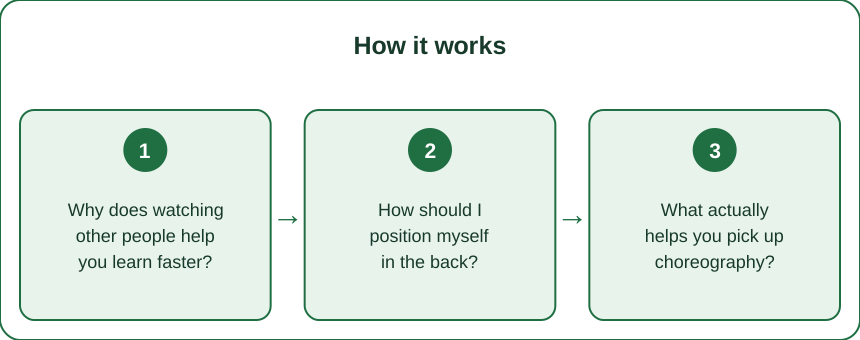
Why does watching other people help you learn faster?
Because copying movement is a primary way humans acquire it.
Observing an action activates many of the same motor regions involved in performing it - a finding at the heart of a substantial body of research on action observation and motor learning. Watching a movement is, in a limited but real sense, practicing it.
Which means the more good models you can see, the better. From the back, you have the instructor plus everyone in front of you. Multiple examples of the same movement help the brain extract the pattern rather than copying one person’s idiosyncrasies.
And whole bodies matter. Choreography is a coordination of feet, hips, and arms together. Seeing complete bodies in motion transfers the pattern better than seeing a head and shoulders in a mirror.
Meanwhile, the front row’s only reference is the mirror image of themselves - which is reversed, focused on one body, and prone to turning the class into self-evaluation rather than learning.
The half-beat advantage is real too. From the back you see the movement fractionally before you need to do it, because you are watching people who are already doing it. That preview is exactly the processing time a beginner needs, and it is unavailable at the front.
How should I position myself in the back?
Not just anywhere in the back - the specific spot matters.
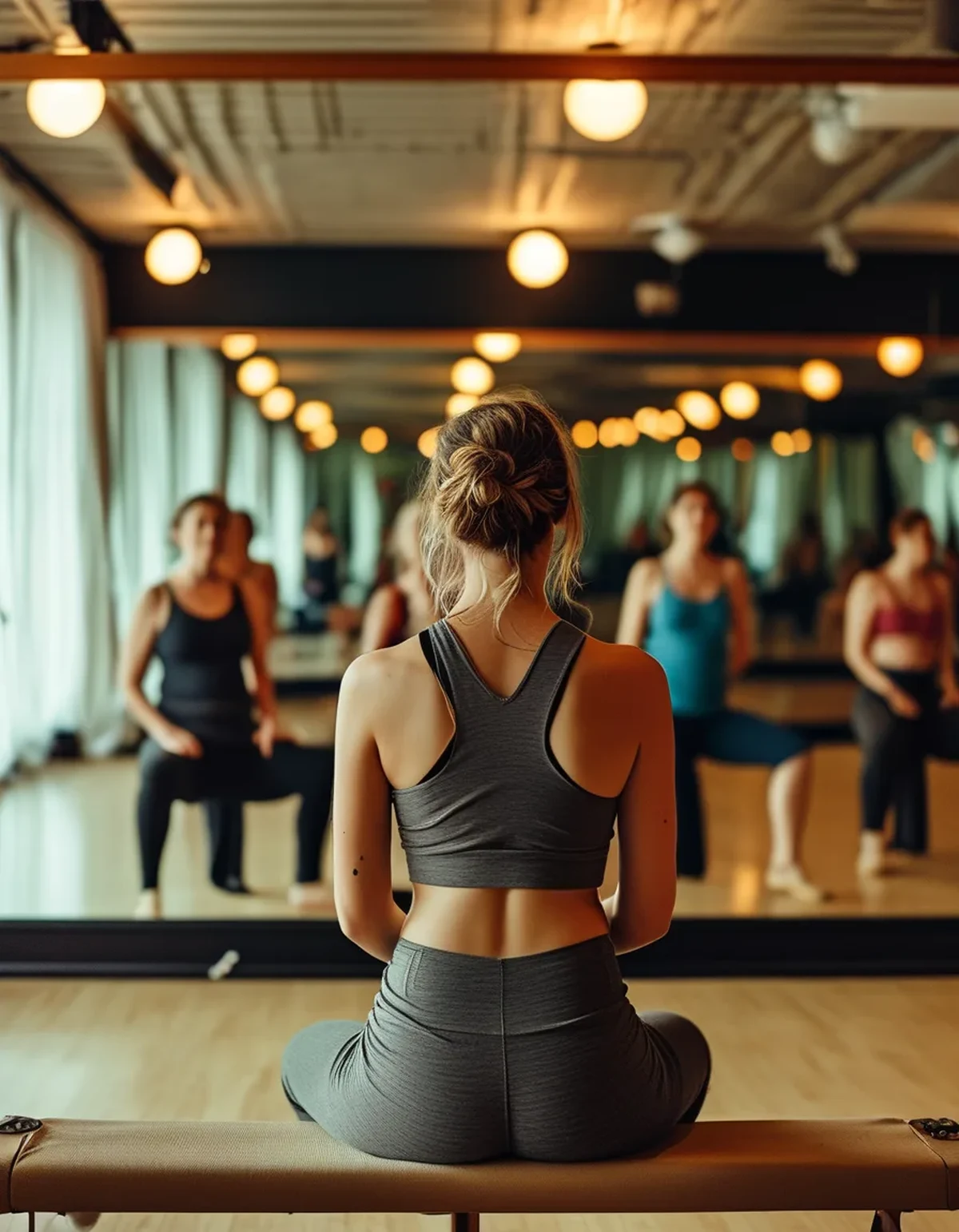
Get a clear sightline to the instructor. The most common back-row error is standing directly behind someone tall. Offset yourself so you can see the instructor’s feet, not just their head, since footwork is where most choreography lives.
Slightly off-center is better than dead center. Center-back is often the most crowded spot and the most blocked.
Pick your anchor person. Find someone mid-room who clearly knows the routine and follow them rather than the instructor when the pace gets fast. They are facing the same direction you are, which removes the mirroring problem entirely - the instructor facing you is showing a reversed image, and translating it in real time is a genuine extra cognitive step.
Give yourself space. Enough room to make a mistake without hitting anyone is enough room to try the full movement. Cramped positioning makes people shrink their movement, which teaches a smaller version of the choreography.
And stay near the edge if you might need to step out. Being able to take a breather without walking through the room removes a real source of hesitation - and hesitation about whether you can pause is what makes people push past their limit.
What actually helps you pick up choreography?
Feet first, and the rest follows in a predictable order.
Learn the footwork before the arms. The legs carry the pattern and the timing; the arms are decoration added afterward. Trying to do both from the first repetition is the most common reason people feel lost.
Let the arms stay simple or absent for the first pass. Instructors expect this. Full arms in the first repetition is not the goal for anyone.
Count out loud, quietly. Saying the count anchors the timing and pulls attention away from self-evaluation. It also stops breath-holding, which is common in beginners concentrating hard.
Watch one repetition without moving at all. This feels like falling behind and it is not. One clean observation is worth three confused attempts - the observation is doing motor learning work.
Expect the third class of a routine to be the one where it clicks. Most people need repeated exposure across sessions, not within one session. The frustration in class one and two is the process working, not failing.
And keep moving even when you are lost. Marching in place on the beat keeps the workout going, keeps you in the rhythm, and lets you rejoin at the next phrase. Stopping entirely is what makes it hard to get back in.
Myth vs Fact: Dance Class Positioning
Myth: The front row is where the committed people stand. Fact: the front row is where people who already know the routine stand. For learning a new routine, the visual information available at the back is objectively better.
Myth: Everyone is watching you. Fact: in a dance class, participants are watching the instructor and the mirror in front of them. From the back, virtually nobody has a sightline to you at all - which is a genuine structural fact, not reassurance.
Myth: If you cannot keep up, you should stop. Fact: marching in place on the beat is a legitimate modification. Cardiovascularly, a modified version at a consistent pace is a real workout, and it keeps you in position to rejoin.
Myth: You should be able to follow a new routine by the end of the first class. Fact: most people need three or more exposures. Instructors build routines expecting to repeat them across weeks.
Myth: Low-impact modifications are the easy option. Fact: keeping intensity while removing impact requires more control, not less. Low-impact done properly is frequently harder - and it is easier to do well from the back, where you have room to adapt.
Does anything change as the fall class season starts?
Yes, and the timing is favorable if you know what to expect.
New sessions start in September, which means routines start from the beginning rather than mid-cycle. Joining at the start of a routine cycle is dramatically easier than joining a class that has been building the same choreography for six weeks - it is worth asking the studio when a new routine begins.
Classes are fuller in the fall. More people means less space, so arriving early to claim a back-row spot with a clear sightline matters more now than at a quiet time of year.
Floors change with heating. Studio floors can become drier and more slippery once heating starts, and traction matters more than cushioning in dance cardio - a shoe that gripped in July may slide in October. Check it before you rely on it.
Cold muscles need longer. Arriving with three or four minutes to move gently before class starts makes the first block feel far better, and the first block is where most people decide whether they can do this.
And a full room is actually a learning advantage. More bodies means more models to watch - the thing that makes the back row work in the first place is amplified in a crowded class.
FAQ: Dance Class Questions, Answered
Will the instructor think I am not committed if I stand at the back?
No - instructors expect newer participants at the back and are used to scanning the whole room. Many will tell you directly that the back is the best place to learn.
What if I cannot see the instructor from where I am?
Move. A sightline is not a luxury in a class built on copying movement - stepping two feet sideways between tracks is completely normal and nobody notices.
How many classes before choreography stops feeling impossible?
Most people report a real shift somewhere around the third or fourth exposure to the same routine. The learning is happening in classes one and two even though it does not feel like it.
TL;DR:
- Watching whole bodies move is how the brain learns choreography - the back row gives you the most models.
- The back row also gives you a half-beat preview, which is exactly the processing time a beginner needs.
- Pick an anchor person facing the same way as you - it removes the mirror-reversal problem entirely.
- Learn the feet first and leave the arms for later. Instructors expect this.
- March in place when you get lost rather than stopping, and rejoin at the next phrase.
- Join at the start of a routine cycle - September is when new ones begin.
Claim a back-row spot with a clear line to the instructor’s feet next class. It is the best seat in the room and it has been mislabeled for years.
Keep Reading
This article is for general informational and styling purposes only. Fit, sizing, and product availability may vary.
